
Why digital safety is no longer only a protection agenda, but a future-readiness agenda, and what Europe, Romania, platforms, schools, families, and civil society must do next
A child does not “go online” anymore
What if the most misleading sentence adults still use about children and technology is this one: the digital future is coming?
It sounds responsible. It sounds strategic. It sounds like the language institutions use when they want to signal vision. But it is already outdated. For children and adolescents, digital is not a future scenario and not a separate sphere they occasionally enter after homework. It is part of the structure of everyday life, of friendship, of school, of identity, of entertainment, of anxiety, of belonging, of visibility, of exclusion, and increasingly of emotional coping.
A child wakes up and checks messages. A class group is already active. A meme from last night becomes a topic in the hallway before the first lesson starts. A rumor begins in a feed and lands in a classroom. A manipulated image circulates before any adult knows it exists. Homework instructions live on a platform. Validation arrives through views, reactions, streaks, and disappearing notifications. An AI chatbot becomes a study aid for one student, a shortcut for another, and a substitute conversation partner for a third. A video watched “for fun” becomes a recommendation loop. A small embarrassment becomes a searchable archive. A private insecurity becomes a commercial signal.
This is not science fiction. This is ordinary life.
That is why digital safety can no longer be treated as a narrow issue of screen time, content filtering, or parental controls alone. Those matter, but they are not enough to describe the challenge in front of us. The real question is larger: how do we help children grow up as safe, critical, autonomous, and responsible participants in a world where online and offline life are already fused?
That is also why the phrase future ready needs to be handled carefully. A future-ready child is not simply a child who can operate devices, navigate apps, or adapt to new tools quickly. A future-ready child is one who can understand context, question incentives, verify information, recognise manipulation, set boundaries, ask for help, participate constructively, and remain grounded in human relationships while living inside systems designed to capture attention.
Europe is becoming more digital, but not automatically more prepared
Across Europe, the policy direction is clearer than it was a few years ago. The Digital Services Act has established a stronger framework for platform responsibility, and the European Commission’s July 2025 Article 28 guidelines clarified that platforms accessible to minors should address grooming, cyberbullying, harmful content, problematic use, manipulative commercial practices, and age-inappropriate experiences through proportionate measures. The EU has also moved from general principles to technical infrastructure, through its age-verification blueprint in 2025 and its April 2026 push for common privacy-preserving age-verification solutions.
This matters because the debate has shifted. Europe is no longer asking only whether children face serious online risks. That question is settled. The debate is now about what kinds of protections are proportionate, enforceable, privacy-preserving, and fast enough to matter in children’s actual lives.
That same diagnosis also emerged clearly in the Digital Safe, Future Ready round table organised by Smart Everything Everywhere. The most useful contribution of that discussion was not alarmism, but clarity: children are already growing up across online and offline spaces at once, and the policy mistake is to talk as if digital were still a coming wave rather than the environment already shaping identity, learning, relationships, and risk.
Romania is very much part of this European picture, but not yet at the level of coherence the moment demands. The Better Internet for Kids Policy Monitor shows that Romania has moved forward through awareness campaigns, safer internet initiatives, and increasing policy attention, yet the ecosystem still looks uneven. Digital safety is recognised. Digital citizenship is discussed more often. But the institutional links between education, child protection, youth policy, digital rights, and platform governance remain weaker than they need to be.
This is why the Romanian conversation must resist two temptations at once. The first is complacency, the idea that because children are highly connected, they are therefore digitally competent. The second is panic, the idea that because risks are real, blunt restriction is the only serious answer. Europe’s current experience suggests that neither position is good enough.
The real divide is not online versus offline. It is prepared versus unprepared
Adults still often describe the issue as if children need to be kept away from “the internet,” as though digital life were a separate territory. But for most children there is no neat border anymore. The more useful distinction is not online versus offline, but prepared versus unprepared.
A child can be highly fluent and still highly vulnerable. They may know how to edit video, maintain group chats, use AI prompts, and switch across platforms with ease, yet still struggle to recognise coercion, identify sponsored influence, verify a claim, recover from harassment, understand data extraction, or resist algorithmic pressure. Fluency is not the same as judgment.
This is where many adult strategies fail. They overestimate technical familiarity and underestimate developmental readiness. They confuse access with competence, exposure with resilience, and connectivity with autonomy. As a result, adults often intervene either too late or too superficially.
A future-ready agenda has to correct that mistake. It must treat digital readiness as developmental, relational, ethical, and civic, not merely technical.
Multiple perspectives from across Europe
A productive European conversation is emerging because different sectors are finally saying, in different ways, that the old model is no longer acceptable.
From a rights and enforcement perspective, the message is that platforms cannot keep treating children’s safety as a side issue. The DSA, the Commission’s guidance, the age-verification work, and national enforcement actions all point in the same direction: risk mitigation for minors has to be real, not rhetorical.
From an education and media literacy perspective, the message is that children do not become safer only by being warned. They become safer when they build judgment, critical thinking, emotional awareness, and the confidence to act when something feels wrong. This means teacher preparation, pedagogical quality, and repeated practice matter more than one-off awareness campaigns.
From a family and public-health perspective, the message is that the problem cannot be reduced to devices alone. Digital habits are tied to sleep, stress, peer pressure, identity formation, attention, loneliness, and community alternatives. If children experience the phone as their main social security object, the issue is not only technical. It is relational.
From a democratic perspective, the message is equally important. Disinformation, online hate, deepfakes, manipulative design, and emotional dependency on algorithmic systems are not just individual safety issues. They affect trust, participation, public culture, and civic life. A child who grows up unable to evaluate information or exercise rights online is not being prepared for democratic citizenship.
These perspectives do not compete. They complete one another. Europe’s most promising work is happening where these lenses begin to connect.
European practices worth studying and adapting
Europe does not yet have a perfect model. It does, however, have useful examples.
Finland, treating media literacy as public infrastructure
Finland is often cited because it treats media literacy less as an optional add-on and more as a long-term public capability. The value of that example is not that Finland has solved online harm. It has not. The value is that it normalises the idea that critical thinking, media literacy, and digital resilience belong inside mainstream education and public policy, not only in project-based interventions.
France, refusing to separate bullying from cyberbullying
France is useful because it has pushed hard on the reality that children’s online lives cannot be regulated as though they were detached from school climate, violence prevention, or emotional well-being. It has also been willing to act against pornography exposure and to press the political argument that age assurance must become more credible. Even where one may disagree with the speed or shape of particular measures, France has at least forced the question of deliverability into the open.
Ireland, translating principles into enforceable service obligations
Ireland’s experience through Coimisiún na Meán is especially important because it shows what happens when principles are turned into actual obligations. The Online Safety Code is not the whole answer, but it demonstrates that design choices, adult-content access, reporting pathways, and child-safety standards can be framed in ways that platforms cannot dismiss as mere aspiration.
Spain, expanding the perimeter of responsibility
Spain’s debate is valuable because it stretches the child-safety question beyond platforms alone. The discussion includes parental controls, criminal law responses to sexual deepfakes, and the broader obligation to create age-appropriate digital environments. The core insight is right even where implementation remains difficult: the burden cannot be left only to children and parents.
The EU level, trying to combine safety with proportionality
At EU level, the most important lesson is that safety and rights do not have to be framed as opposites. The Commission’s current work on age verification tries, at least in principle, to combine proof of age with privacy, data minimisation, and interoperability. That matters. Europe should not be forced into a false choice between protecting minors and protecting rights.
Romania, the gap is not awareness alone, but system maturity
Romania’s challenge is less about recognising that a problem exists and more about system maturity. Awareness is present. Concern is present. Projects exist. But the ecosystem still needs stronger links between schools, youth work, parent support, child-rights thinking, and regulatory literacy. Without that, digital safety remains episodic, not structural.
What these European examples actually teach
Several lessons become clear when these examples are placed side by side.
- First, there is no serious child-safety policy without serious adult capacity. Laws matter. Tools matter. But if teachers, parents, youth workers, and public institutions do not know how to interpret or use those tools, much of the protection remains symbolic.
- Second, design matters more than messaging. It is easier to tell children to be careful than to redesign systems that profit from their attention. But the evidence increasingly shows that optional safety tools, hidden settings, and user-burdened protections do not reach those most at risk.
- Third, regulation without implementation breeds impatience, and impatience breeds simplistic politics. When enforcement is too slow or too invisible, bans gain appeal not only because they are ideologically attractive, but because they look like action.
- Fourth, education is not an afterthought. It is not the softer complement to the “real” work of regulation. It is part of the real work. A child who is blocked today but left unprepared tomorrow is not safer in any durable sense.
- Fifth, child safety cannot be separated from wider social conditions. Offline alternatives, trusted adults, mental-health support, school climate, and public trust all shape digital vulnerability.
What Europe is still getting wrong, even when the direction is right
Europe is moving in the right direction, but several weaknesses remain visible.
Too often, institutions announce concern without building enough implementation capacity. Too often, protection is discussed in legal language that does not translate well into school life, family life, or youth work. Too often, young people are invited into consultations only after the main architecture has already been designed.
The debate is also still vulnerable to false binaries: freedom versus safety, education versus regulation, privacy versus age assurance, protection versus participation. In practice, the task is not to choose one side. It is to design combinations that are proportionate and credible.
There is also still a tendency to focus on visible symptoms rather than business incentives. Infinite scroll, autoplay, engagement loops, push notifications, social pressure signals, and rapid recommendation chains are not neutral. They are product decisions tied to revenue logic. Europe will keep running behind the problem if it regulates only outcomes and not the design conditions that help produce them.
What this means for decision-makers in Romania right now
Romania does not need to wait for a perfect European settlement before acting, but it also should not confuse activity with strategy.
The immediate priority should be coherence. Child online safety should not float between education, digitalisation, consumer protection, communications, child protection, and youth policy without a clear logic of coordination. The second priority should be adult preparation, especially for teachers, school leaders, youth workers, and parents. The third should be rights-compatible technical infrastructure, so that future age-assurance or safety-by-default measures do not arrive as a shock to public trust.
Most importantly, Romania should treat digital safety as a long-term educational and democratic issue, not as a passing moral panic.
GEYC’s point of view is inspired by fieldwork
At GEYC, we do not approach digital safety as a niche issue or a seasonal campaign theme. We approach it as a lived civic and educational reality.
That position comes from experience, from working with young people who are already navigating creativity, pressure, influence, participation, confusion, and exposure in the same digital spaces. It comes from working with teachers who are expected to develop critical thinking in environments where platform logic is already shaping attention. It comes from working with parents and youth workers who feel responsible but often under-equipped. And it comes from seeing, repeatedly, that the same young person can be digitally fluent in one sense and digitally vulnerable in another.
From that experience, GEYC’s position can be summarised in five convictions.
- Digital safety is inseparable from digital citizenship. Children do not become safer only by being blocked, monitored, or warned. They become safer when they develop judgment, voice, empathy, discernment, boundaries, and responsibility toward themselves and others. Our Youth Empowerment portfolios (coordinated by Alexandra-Florentina Peca with support from VP Elena Druta) and Future Skills (coordinated by Adelina Dragomir with support from VP Alex Craciun) are strategically collaborating to make digital citizenship education a priority.
- Digital readiness is developmental, not merely technical. The key question is not only whether a young person can use a tool. It is whether they can understand a context, question an incentive, verify a claim, navigate a conflict, and make a decision aligned with their values and well-being.
- We need ecosystems, not isolated interventions. A one-off workshop cannot carry the burden of what platforms, schools, families, regulators, and communities have failed to coordinate. It can help, but it cannot compensate for structural incoherence.
- Young people must be co-shapers, not only recipients. Adults often design policies and programmes for young people without involving them adequately in naming risks, describing trade-offs, or imagining better environments. Participation is not decorative. It is diagnostic.
- Future readiness is democratic. Online hate, disinformation, cyber violence, manipulative persuasion, and platform-driven polarisation sit at the intersection of safety and democracy. A child who grows up unable to evaluate information, assert rights, or engage constructively online is not being prepared for citizenship in the 21st century.
Why GEYC highlights the PRISMA Framework here
The PRISMA Framework for Digital Democracy and Citizenship matters because it captures something traditional online-safety discourse often misses: many digital harms are not isolated incidents. They are symptoms of wider democratic, educational, and social fragilities.
PRISMA focuses on strengthening democratic values and digital citizenship across Europe and speaks directly to digital exclusion, disinformation, online hate, cyber violence, and education on digital rights and responsibilities. That matters because many of the harms now dominating the child-safety debate, compulsive use, deepfakes, manipulative design, harassment, harmful recommendation loops, emotional overdependence on digital systems, are not only safety issues. They are also issues of power, participation, trust, rights, and public culture.
This is why GEYC sees PRISMA as practical infrastructure for the kind of long-term response Europe now needs. Through the PRISMA framework and its operating grant, GEYC and partners are building national Digital Democracy Labs, coordinating European Digital Citizenship Week activities, convening exchange and learning spaces, and strengthening a broader network committed to meaningful civic engagement and digital innovation.
For children and adolescents, the implication is straightforward. A child does not become safer online only by learning what to avoid. They become safer when the surrounding culture gives them repeated chances to practise what constructive participation looks like: questioning information, understanding rights, recognising manipulation, discussing ethical dilemmas, setting boundaries, responding to harm, and linking digital experiences to wider social realities.
If Europe’s response stops at age gates and enforcement actions, it will remain incomplete. If it adds sustained investment in digital citizenship and democratic resilience, it has a far better chance of producing not only safer children, but stronger societies.
What GEYC’s portfolio already shows, when digital citizenship is treated seriously
GEYC’s positioning on digital safety is grounded in programmes that already connect online safety, critical thinking, media literacy, democratic participation, and educator support in practical ways.
An example is Pixels of Change, through which GEYC has worked with high-school students in Romania aged 14 to 19 to develop digital competences and become active citizens in their communities. The wording matters. The objective is not competence acquisition in a narrow technical sense, but active citizenship.
At a wider European level, GEYC and PRISMA European Network coordinated the European Digital Citizenship Education Week 2025, implemented with the support of our colleagues Lina Boicu and Gabriel BREZOIU, involving several countries, local events, youth workers, educators and partner organisations in activities related to media literacy, online safety and wellbeing, participation, inclusion and digital rights. This reflects the integrated model that GEYC advocates for: safety becomes more sustainable when embedded in a wider culture of rights awareness and meaningful participation.
GEYC’s wider EDU community logic reinforces the same approach. Digital safety does not scale only through one organisation’s workshops. It scales when educators, youth workers, peer leaders, and partner organisations can carry methods into their own schools and communities.
What the Smart Everything Everywhere discussion helped clarify
The Smart Everything Everywhere conversation Digital Safe, Future Ready round table is worth naming directly because it sharpened several points that often get blurred in policy language. Our Head of Future Skills, Adelina Dragomir, was there and insisted that digital citizenship education starts far too late and that methods matter just as much as messages. She spoke about the need for an approach based on experience, comparison, reflection, and the ability to react in situations of online abuse, rather than merely transmitting abstract information. She also highlighted one of the important lessons from the field: without prepared adults, there can be no prepared children, and without a shared language between schools, parents, organizations, and decision-makers, children receive contradictory messages and end up alone in a space that adults claim to control, but often do not understand well enough.
The conversation revolved around the idea that access is not the same as competence. Children may spend hours online and still lack the ability to verify information, read incentives, identify manipulation, or understand how a system is shaping their behaviour. That is why one of the strongest ideas in that discussion was that education needs to provide not just more information, but structured and verified information. The problem is not that children are disconnected. The problem is that many are connected without enough interpretive support.
Second, the round table made clear that digital safety is also an emotional and relational issue. The challenge doesn’t come only from exposure to harmful content, but the way validation loops, dependency, loneliness, and AI-mediated interaction can reorganise a young person’s inner life. One of the warnings repeated there was that children need cognitive autonomy, not only technical instructions. A young person may know how to open an app, generate an image, or prompt a chatbot and still not understand what kinds of emotional projection, passivity, or false intimacy those tools can invite.
Third, the discussion strongly reinforced a point GEYC has repeatedly seen in practice: there are no prepared children without prepared adults. The clearest formulation was about teachers. Devices, platforms, and classroom technology may arrive faster than pedagogical capacity, but digital competence in schools will remain fragile until educators themselves are supported to teach critically, not only operationally. The same applies to families. One of the most grounded messages from that conversation was that support for parents cannot be treated as secondary, because many digital habits are formed long before school interventions become systematic. In some cases, adults wait until the third or fourth grade to react, when patterns of use, dependency, and avoidance are already well established.
The discussion also exposed the limits of harsh control. Some children experience the phone as refuge, status, companion, or emotional support. This does not mean giving up on boundaries. It means that preparation requires conversation, trust, clear priorities, and meaningful alternatives.
Finally, the Smart Everything Everywhere discussion widened the frame beyond the screen itself. It connected online safety to exhaustion, isolation, poverty, functional illiteracy, weak community infrastructure, and the lack of attractive offline spaces for children and adolescents.. A society that closes libraries, underfunds youth spaces, and leaves families unsupported should not be surprised when platforms become the default place where belonging, distraction, identity, and escape are sought. Digital safety therefore cannot be built only with app rules. It also depends on whether children have other places, people, and rhythms that help them grow.
Future ready means more than digitally skilled
Too much public language around future readiness is still reduced to employability, innovation, entrepreneurship, or adaptation to AI. These matter, but they are incomplete. Children do need digital skills. They also need civic judgment, emotional balance, ethical orientation, and the ability to remain human in systems built to optimise engagement.
Future ready means being able to use technology without becoming reducible to it. It means understanding not only what a tool can do, but what it is asking of your attention, your data, your emotions, and your choices. It means being able to participate without being passively shaped at every step by platform incentives.
That is why digital safety and future readiness belong in the same conversation.
Emotional autonomy matters as much as technical literacy
One of the most underestimated dimensions of digital safety is emotional autonomy. A child may know the rules of a platform and still become dependent on the validation it offers. They may understand that an AI system is not a person and still use it to fill loneliness. They may know that a feed is curated and still feel compelled to return to it when tired, bored, excluded, or uncertain.
This is why education for digital safety cannot be reduced to technical warnings. It has to include discussions about belonging, self-worth, peer pressure, shame, boundaries, and meaning. It has to help children recognise when a tool is helping them and when it is beginning to organise their emotional life around speed, reaction, and comparison.
Future readiness therefore requires cognitive autonomy and emotional literacy together. Without them, technical skills can coexist with deep vulnerability.
Schools cannot outsource this, but they cannot carry it alone either
Schools remain central because they are one of the few institutions that can reach almost every child, repeatedly, over time. But schools cannot carry the full responsibility for a digital environment they do not control. For instance, Selly – one of the largest content creators on Youtube in Romania highlighted the challenge for a teacher to compete in the classroom with the more appealing social networks that are ultimately distracting attention. We need to use technology as a support tool and avoid our attention being affected by it.
Teachers need more than devices and logins. They need training that is pedagogical, developmental, and practical. They need language for discussing manipulation, consent, image-based abuse, AI, misinformation, and online conflict without reducing everything to rule-following. They need methods that allow students to compare, reflect, debate, verify, and respond.
At the same time, schools need backup. Parent education cannot remain optional or marginal. Youth work and non-formal education matter because many digital realities, belonging, humour, identity play, shame, experimentation, happen outside the formal curriculum. Child protection services, safer internet centres, and local support ecosystems also matter because not every risk can be solved inside the classroom.
This is why the responsibility has to be shared. Schools are essential, but they are not sufficient.
Families need support, not guilt
Parents are often described as the first line of defence, but too often they are treated as if responsibility alone automatically gives them capacity. It does not.
Many parents are navigating contradictory advice, unclear technical tools, platform opacity, and children who often know the interface better than they do. Some intervene late. Some overreact. Some avoid the conversation because they feel overwhelmed. None of this is solved by guilt.
What families need is practical support: clearer age-appropriate guidance, better default protections, accessible reporting pathways, conversations that move beyond “don’t do that,” and support structures that appear before a crisis, not only after one. The goal is not perfect parental control. It is competent, ongoing, trust-based accompaniment.
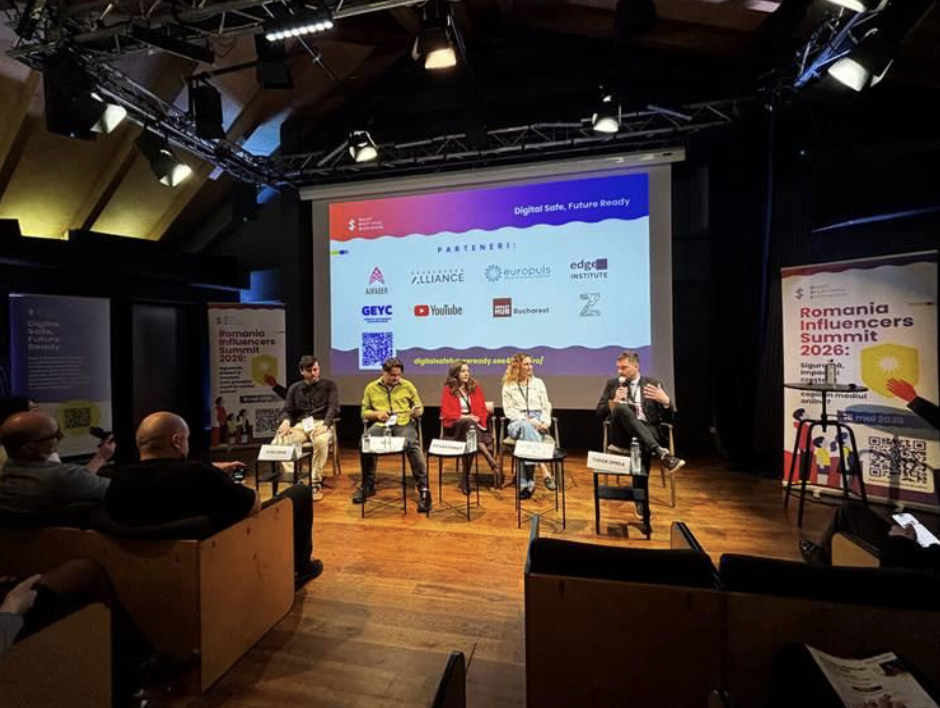
Effective parenting in the digital age is based on dialogue and shared rule-setting with children, rather than strict control, and on maintaining open conversations about their online experiences instead of relying on digital devices as a way to manage behavior. During the 2026 Influencers summit in Bucharest, Romania it was emphasized the need for better communication and cooperation between schools, nonformal education actors, families, content creators, authorities and tech companies.
Platforms must stop treating child safety as an accessory feature
The platform question is no longer whether companies can produce child-safety messaging. They can. The real question is whether they are willing to redesign product logic where that logic conflicts with revenue.
If a service depends on attention maximisation, then the features that drive attention, autoplay, infinite scroll, algorithmic acceleration, social pressure signals, frictionless recirculation, and hidden or low-uptake safety tools, cannot be treated as marginal. They are the architecture.
This is why the debate has moved toward design and default settings. Safety that depends on users finding a buried setting is weak safety. Safety that depends on children self-regulating against deliberately persuasive systems is not really safety at all.
What the Beyond the Ban discussions reinforced
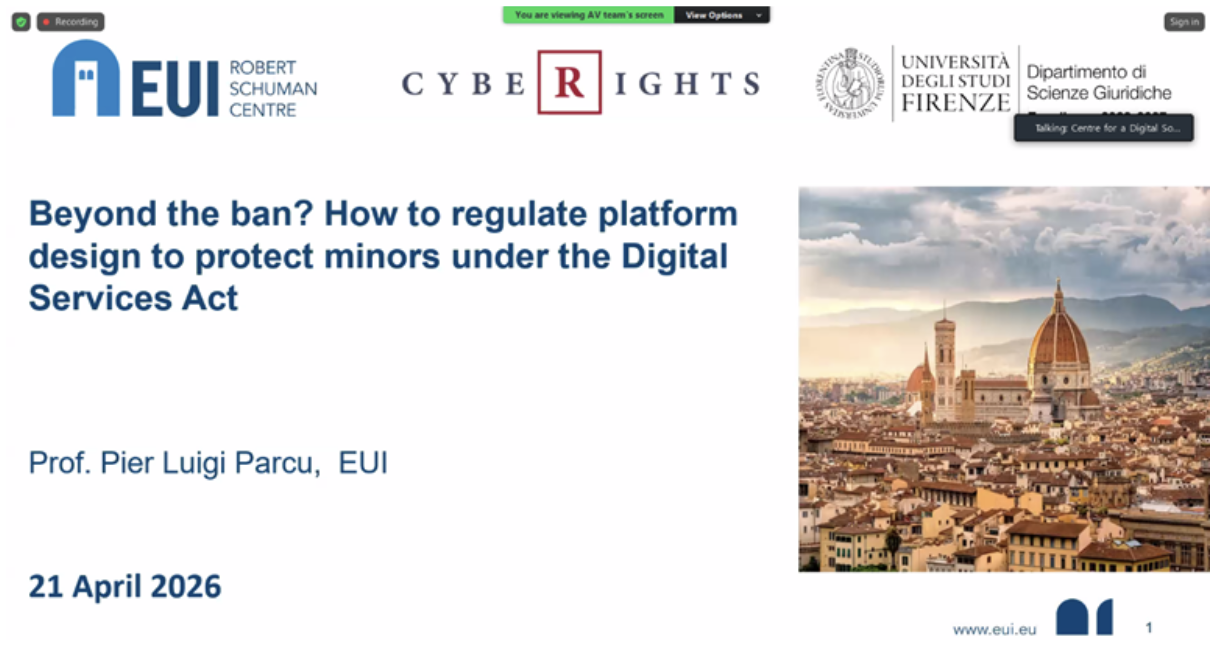
The two Florence sessions added useful clarity. They reinforced, rather than changed, the core conclusion.
From the first session, Giovanna Mascheroni, Professor of Sociology of Digital Media at Università Cattolica del Sacro Cuore, warned that “opportunities and risks go hand by hand” and reminded the room that “risk does not necessarily mean harm.” She also showed why complacency is impossible, noting the increase in online harm and the rise of cyberbullying, while stressing that younger teens can be “really persuaded by the human-like features of AI.” Her perspective matters because it rejects both panic and naivety.
Amanda Third, Professorial Research Fellow and Co-Director of the Young and Resilient Research Centre at Western Sydney University, argued that Australia’s social media restriction was driven by a “very real set of concerns” but also by “viral policymaking in action.” Her warning was sharp: when governments rush to act, they may still fail to “meet that gold standard of evidence-based policymaking.” She insisted that regulation should target harmful features, not only access categories, and that the real question is not only how to prevent harm, but “what would an optimal digital environment deliver for children?”
Marta Vega Bayo, Head of the Unit for Platforms and Data Regulation at Spain’s Ministry for Digital Transformation and Civil Service, underlined that “not any age verification system is adequate” and that states must avoid measures that become means of “identification of users or tracking and profiling users.” She also stressed that minors should not be forced “to be left out of the digital ecosystem” and that protection requires a “holistic multidisciplinary approach.” That is an important corrective to simplistic solutions.
Katarzyna Szymielewicz, lawyer and President of the Panoptykon Foundation, said bluntly that social media design is still driven by “advertising revenue at the cost of minors’ safety and well-being.” She described parental controls as “nice to have tools” that remain superficial while platforms continue to maximise time spent, and she warned that two years of DSA implementation “did not deliver a meaningful change” yet. Her conclusion was not anti-regulation, but more demanding regulation, one that tackles manipulative design and not only access.
Greta Faieta, Legal Expert at the European Commission, DG CNECT, reminded participants that protection of minors is “at the heart of the DSA” and explained that the guidelines are the Commission’s reading of what Article 28 should mean in practice. She highlighted the “rabbit hole” effect and said recommender systems should not amplify content that may be harmful when repeatedly encountered by minors. Her emphasis on children as rights holders, not merely objects of protection, is crucial.
From the second session, the tone became even more operational.
Peter Chapman, Associate Director at the Knight-Georgetown Institute, argued that “risk assessment is quite descriptive in the DSA context” and that there is still too little evidence showing whether listed mitigations actually reduce harm. Drawing from US litigation, he pointed to internal data suggesting that some highly promoted safety tools are barely used. His intervention matters because it shifts the debate from promises to measurable effectiveness.
Jeremy Godfrey, Executive Chairperson of Coimisiún na Meán, called the Article 28 guidance “a fantastic work” but summarised the real short-term priority in three words: “enforcement enforcement enforcement.” He also warned that “the world as it is today is a long way away from that ideal” of child-safe services. His contribution made one thing clear: good guidance without visible consequence will not satisfy public concern.
Frédéric Bokobza, Deputy Director General at ARCOM, described the political reality with unusual candour. In France, he said, “there’s got to be a ban,” not because bans are the whole answer, but because there is “impatience for results.” At the same time, he insisted that “the proper level for all this protection of minors online action is the European level.” That tension, between national impatience and European coherence, is one of the defining tensions of the moment.
Michael Terhörst, Head of the Federal Office for the Enforcement of Children’s Rights in Digital Services, described a familiar sequence. Before the guidelines, some providers said they were waiting for clarity. After the guidelines, some said they were only soft law. His response was direct: “We love the guidelines,” and “there’s no room for negotiation at this time, for safe online environment.” He also warned that some harmful services remain difficult to tackle because of exemption thresholds, a point Europe should take seriously.
Susanne Lackner, Vice Chairperson of KommAustria, stressed that “there is a high sense of urgency,” but also that “age assurance is a prerequisite” and “not only a technical issue.” She insisted that privacy-preserving design and public support structures must move together, and she strongly emphasised the role of safer internet centres and intermediary organisations.
Across both sessions, the Q&A sharpened four points. First, self-declared age is not meaningful protection. Second, Europe needs clearer interaction between national measures and DSA logic. Third, much of today’s internet was not designed with children in mind, which means defensive regulation is necessary but not sufficient. Fourth, the DSA already contains powerful tools, but it may still need faster enforcement pathways and a closer look at blind spots such as smaller but risky services.
Public institutions must build trust infrastructure, not only announce concern
A recurring weakness in digital-safety debates is that public institutions often speak in two registers at once. They express legitimate alarm, but remain fragmented, reactive, or unclear about implementation.
That gap is dangerous. When institutions only voice concern, they create expectations without capacity. When they legislate without infrastructure, they create rules without trust. When they rely on private action without public accountability, they weaken legitimacy.
This is why the current European moment matters. The combination of DSA enforcement, Article 28 guidance, the child online safety discussions at EU level, and the age-verification work shows an attempt to move beyond principle toward actual public-interest architecture. Romania should treat this as an invitation to build coherent institutions, not just louder narratives.
Young people are not the problem to be solved. They are part of the solution to be built
One of the most important corrections in this debate is to stop speaking about children only as passive recipients of risk. They are not. They are observers of platform culture, early detectors of change, peer educators, and interpreters of social norms. They often know where the real pressure points are long before adults do.
That does not mean responsibility should be pushed onto them. It means effective policy and education should include them earlier and more seriously. Participation is not a decorative exercise in legitimacy. It improves diagnosis and usually improves design. This was also strongly echoed in the 2026 Influencers summit in Bucharest, Romania, where participants stressed that young people should be meaningfully involved in shaping decisions that affect their digital lives, as adult-only perspectives often fail to fully capture the realities, pressures, and behaviors that define how younger generations actually experience online environments.
This is something our team truly believes in. Even recently we took part at the Influencers summit in Bucharest where we underlined that youth are very dynamic, school curricula needs to embed AI & digital education as a horizontal approach to all subjects and content creators play a fast response & educational role complementing the teachers.
A practical agenda, from control toward preparation
A credible future-ready agenda should include at least six commitments.
- Start earlier, because by the time many children reach later primary school, digital habits are already formed.
- Invest in teachers continuously, not just in equipment, because infrastructure without pedagogy widens the gap between formal policy and everyday practice.
- Support parents and families with practical, accessible guidance before crisis points.
- Push platforms toward safety by design and by default, not only optional user tools.
- Build privacy-preserving public-interest technical infrastructure, especially for age assurance where proportionate and necessary.
- Treat digital citizenship as a democratic capability, not an etiquette module.
- Add real offline alternatives, because libraries, youth centres, clubs, and safe community spaces are not luxuries. They are part of prevention. A child with places to belong offline is less likely to experience the digital world as the only available refuge.
Are adults ready to protect children online well?
The most important conclusion is not that Europe lacks concern. Concern is everywhere. The more difficult question is whether adults are willing to do the slower, more demanding work that real protection requires.
That work includes regulation, but also pedagogy. It includes enforcement, but also trust. It includes age assurance where justified, but also privacy. It includes platform accountability, but also community alternatives. It includes support for families, but also youth participation. Above all, it requires a shift from the fantasy of total control toward the reality of preparation.
Children should not be kept out of the digital world at all costs. They should be helped to become independent, ethical, resilient, and well-supported navigators of a world that will remain digital.
A call to action from GEYC
If this conversation matters to you, do not leave it at the level of agreement.
- Bring it into your school, your organisation, your institution, your family conversations, and your policy work.
- Support approaches that combine safety, rights, participation, and education.
- Join the GEYC community.
- Follow and contribute to the learning opportunities connected to edu.geyc.ro.
- Explore the PRISMA Network and the wider conversations on digital citizenship and democratic resilience.
- Share concrete practices, not only concerns.
- And insist, in every space that matters, that digital safety for children is not a side topic but that it’s a test of what kind of society we are preparing them to inherit – this being also the main message we aim to deliver during the upcoming European Digital Citizenship Education Week (EDCEWeek) between 14 and 20 September 2026.